Other Parsers
This page covers ionique’s specialized parsers. Each is briefly described with its parameters and a usage example.
FilterDerivativeSegmenter
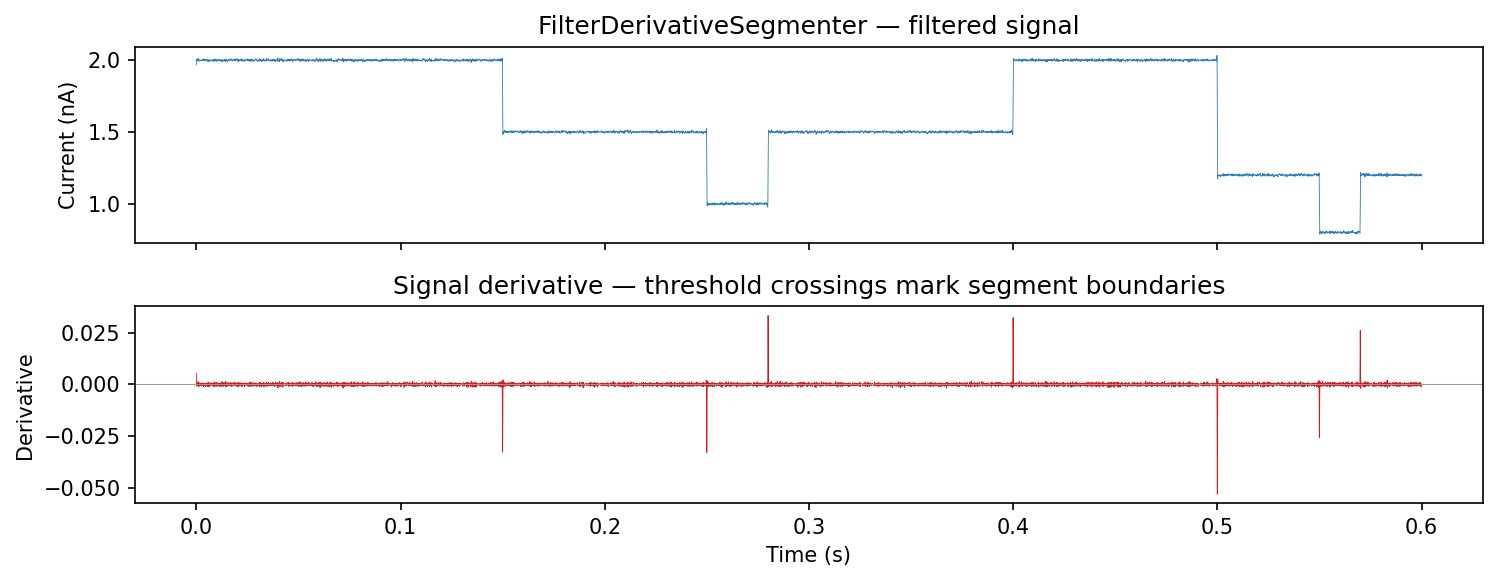
Detects segment boundaries using the derivative of a lowpass-filtered signal. Sharp transitions produce large derivative values that cross a threshold.
Parameter |
Default |
Description |
|---|---|---|
|
|
Lower derivative threshold for transition detection. |
|
|
Upper derivative threshold. |
|
|
Lowpass cutoff (Hz) applied before derivative computation. |
|
|
Sampling frequency (Hz). |
from ionique.parsers import FilterDerivativeSegmenter

parser = FilterDerivativeSegmenter(
    low_threshold=1.5,
    high_threshold=3.0,
    cutoff_freq=2000,
    sampling_freq=100000,
)
trace.parse(parser, newrank="event", at_child_rank="vstep")
NoiseFilterParser
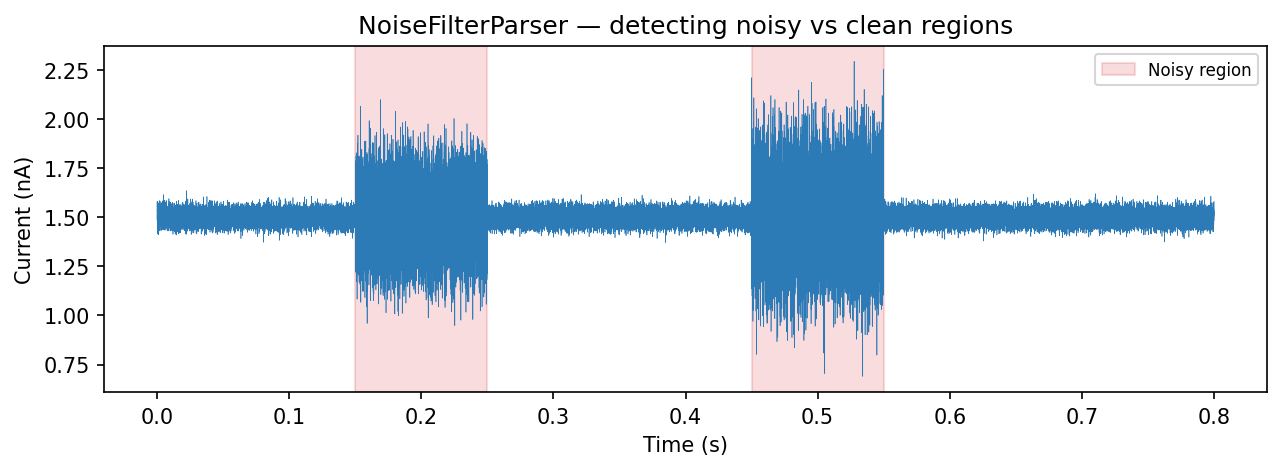
Classifies signal regions as clean or noisy based on local variance. Useful for excluding unstable portions of a trace before event detection.
Parameter |
Default |
Description |
|---|---|---|
|
|
Variance threshold for noise classification. |
|
|
If |
from ionique.parsers import NoiseFilterParser

# Keep only clean regions
parser = NoiseFilterParser(noise_threshold=60, detect_noise=False)
trace.parse(parser, newrank="clean", at_child_rank="vstep")

# Then parse events in clean regions only
trace.parse(event_parser, newrank="event", at_child_rank="clean")
snakebase_parser
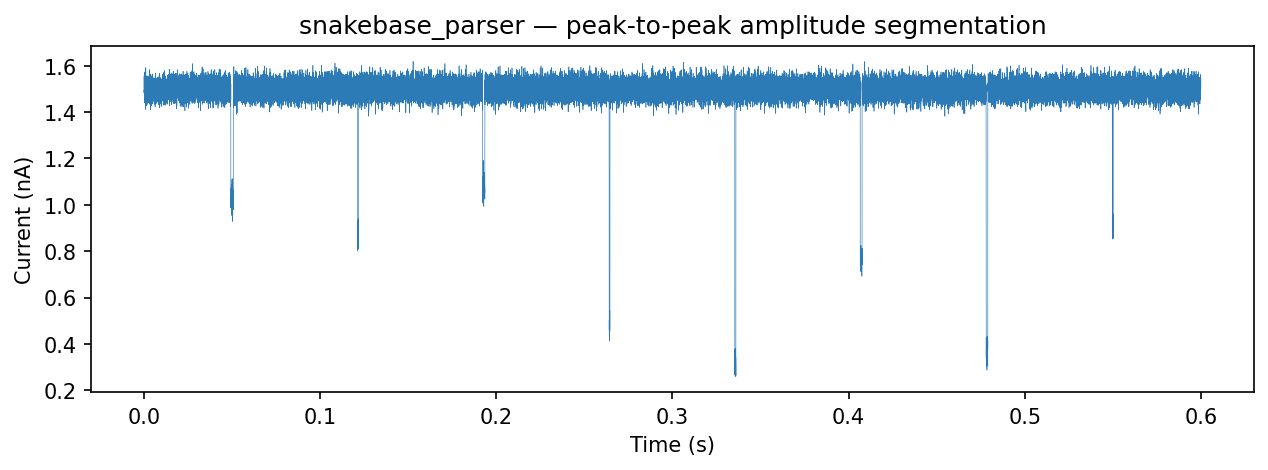
Segments the signal based on peak-to-peak amplitude changes. Detects regions where the local amplitude exceeds a threshold.
Parameter |
Default |
Description |
|---|---|---|
|
|
Amplitude threshold for segmentation. |
from ionique.parsers import snakebase_parser

parser = snakebase_parser(threshold=1.5)
trace.parse(parser, newrank="event", at_child_rank="vstep")
ExclusionParser
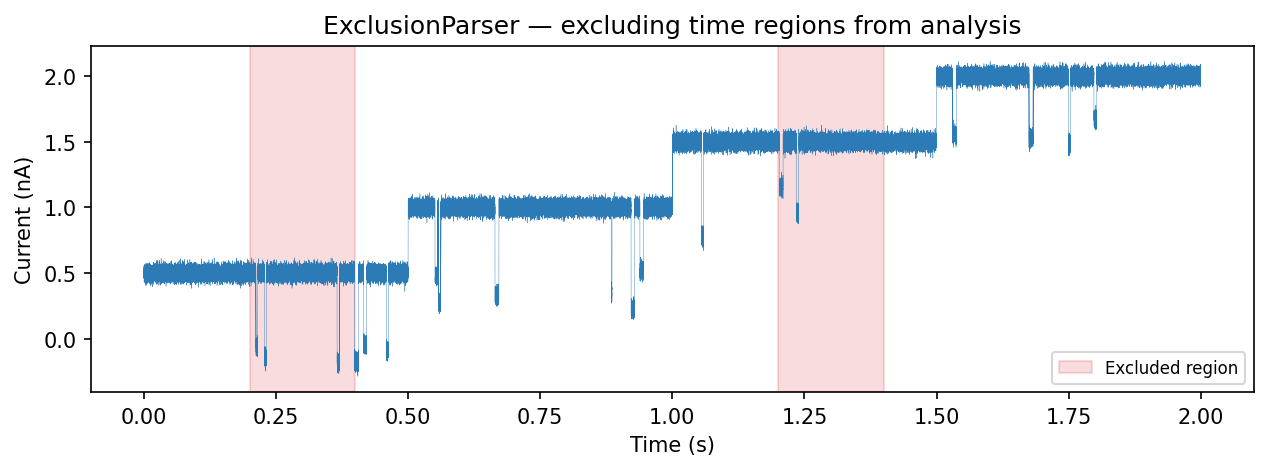
Excludes specified time regions from analysis. The remaining (non-excluded) portions become child segments.
Parameter |
Default |
Description |
|---|---|---|
|
(required) |
List of |
from ionique.parsers import ExclusionParser

# Exclude two noisy time windows
parser = ExclusionParser(regions=[
    (0.2, 0.4),    # exclude 0.2–0.4 seconds
    (1.2, 1.4),    # exclude 1.2–1.4 seconds
])
trace.parse(parser, newrank="clean", at_child_rank="vstep")
lambda_event_parser
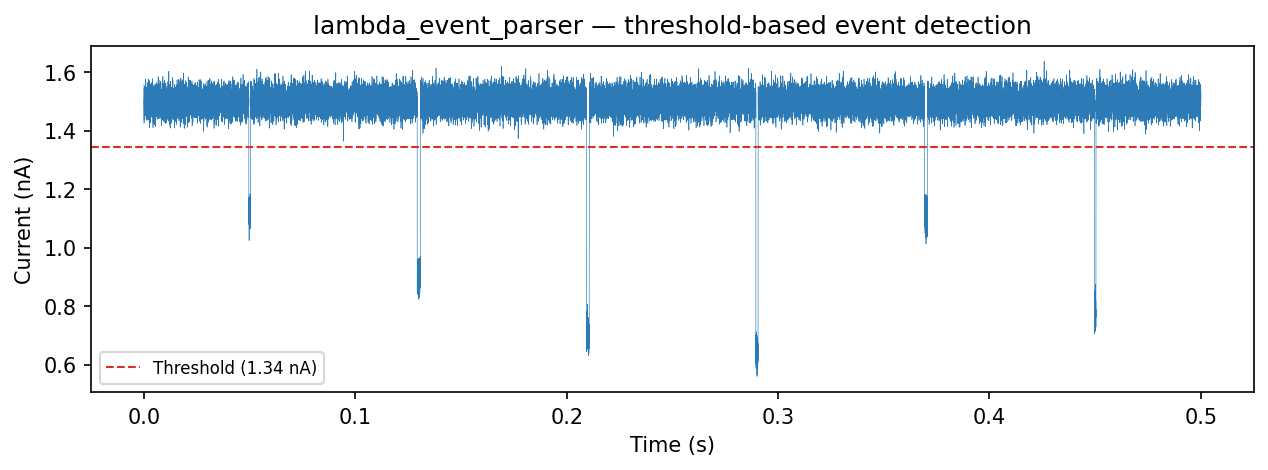
A rule-based parser that detects events using a simple threshold and optional filtering rules.
Parameter |
Default |
Description |
|---|---|---|
|
|
Current threshold for event detection (as percentage of baseline). |
|
|
List of callable rules for post-filtering. |
from ionique.parsers import lambda_event_parser

parser = lambda_event_parser(threshold=85)
trace.parse(parser, newrank="event", at_child_rank="vstep")
IVCurveParser and IVCurveAnalyzer
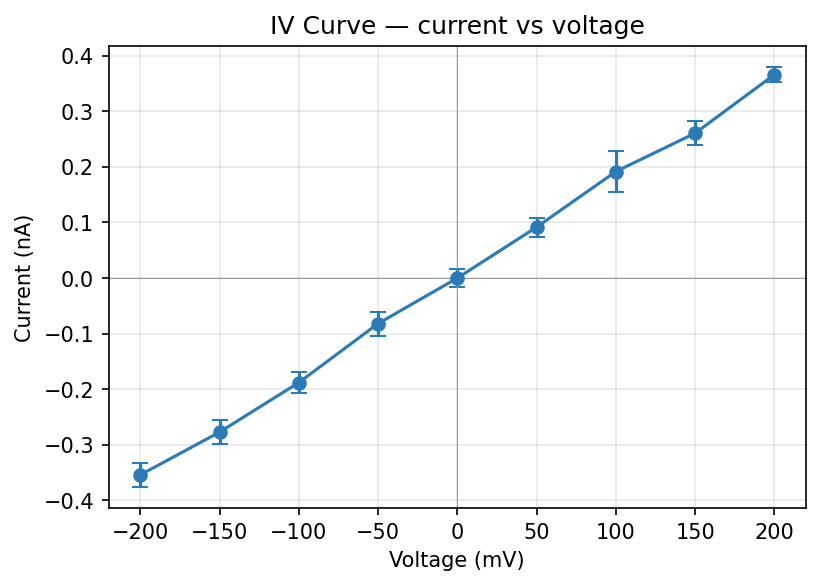
These two classes work together to extract current–voltage (IV) relationships from multi-voltage-step recordings.
IVCurveParser identifies the voltage protocol pattern:
from ionique.parsers import IVCurveParser

parser = IVCurveParser(voltage_array)
patterns = parser.parse()
# Returns matched voltage patterns for IV analysis
IVCurveAnalyzer computes mean current at each voltage level:
from ionique.parsers import IVCurveAnalyzer

analyzer = IVCurveAnalyzer(
    current=current_array,
    parent_segment=vstep,
    sampling_frequency=100000,
    method="simple",
)
iv_data = analyzer.analyze()
# Returns {voltage_value: (mean_current, std_current), ...}
MemoryParse
Reconstructs segments from precomputed boundaries. Useful for loading previously saved analysis results.
from ionique.parsers import MemoryParse

parser = MemoryParse(
    starts=[1000, 3000, 7000],
    ends=[1500, 3800, 7200],
)
trace.parse(parser, newrank="event", at_child_rank="vstep")