AutoSquareParser
AutoSquareParser detects rectangular (square-pulse) blockade events —
the signature of protein or polymer translocations through nanopores. It
identifies regions where current drops below a threshold fraction of the
open-channel baseline.
from ionique.parsers import AutoSquareParser

parser = AutoSquareParser(
    threshold_baseline=0.7,
    expected_conductance=1.9,
)
trace.parse(parser, newrank="event", at_child_rank="vstep")
Parameters
Parameter |
Default |
Description |
|---|---|---|
|
|
Fraction of baseline current that defines an event. A value of 0.7 means any region below 70% of baseline is considered a blockade. |
|
|
Expected open-channel conductance in nS. Used to validate that the baseline is reasonable. |
|
|
Multiplicative tolerance for conductance validation. |
|
|
Number of context samples to include before and after each detected
event (stored in |
|
|
List of callable rules for post-filtering events. Each rule takes a
segment dict and returns |
The parser also requires eff_sampling_freq and voltage to be
available (passed automatically when parsing within a TraceFile tree).
Parameter sensitivity
threshold_baseline
The most important parameter. Lower values require deeper blockades to trigger detection; higher values detect shallower events (but may pick up noise).
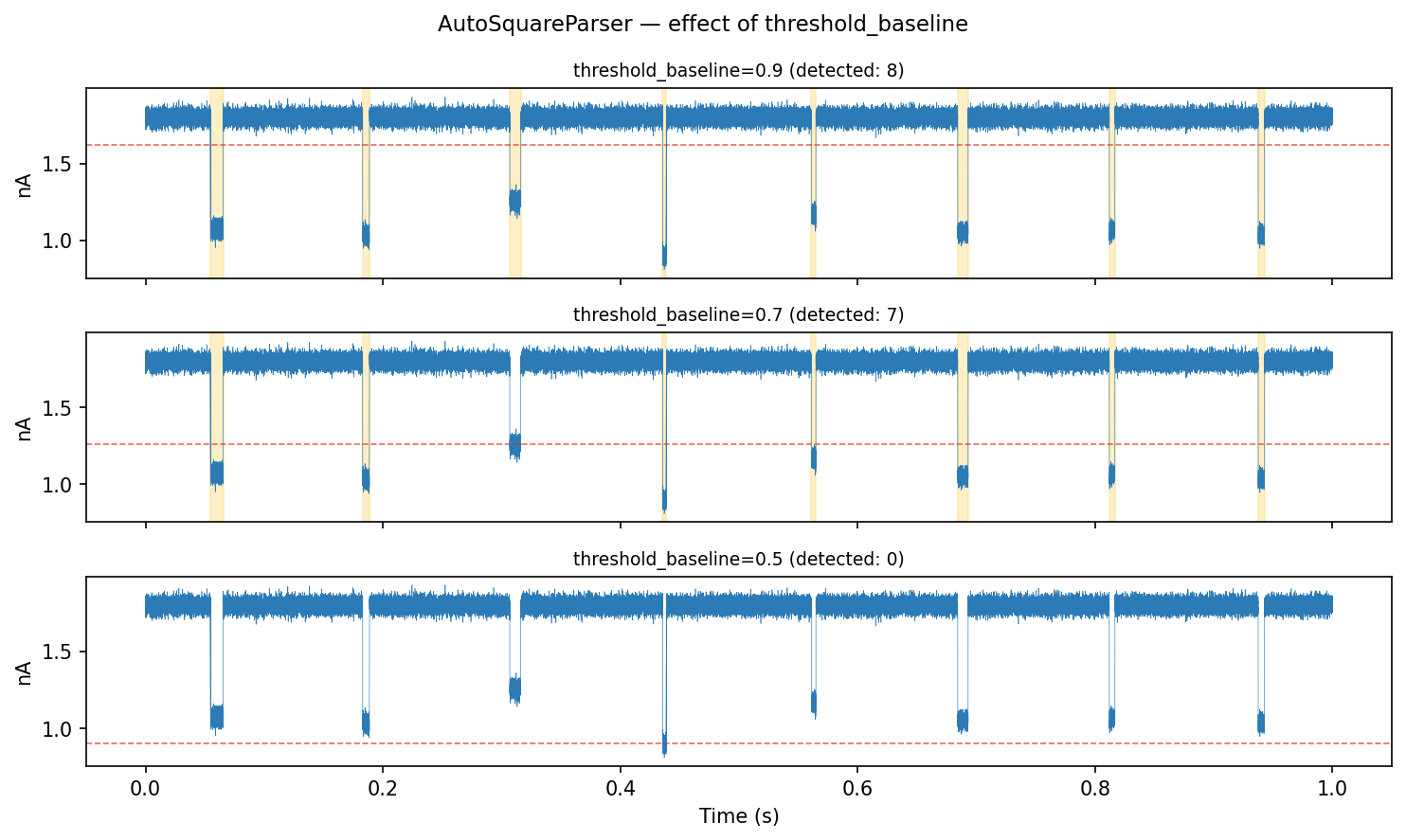
# Sensitive: detect shallow blockades
parser = AutoSquareParser(threshold_baseline=0.9)

# Strict: only detect deep blockades
parser = AutoSquareParser(threshold_baseline=0.5)
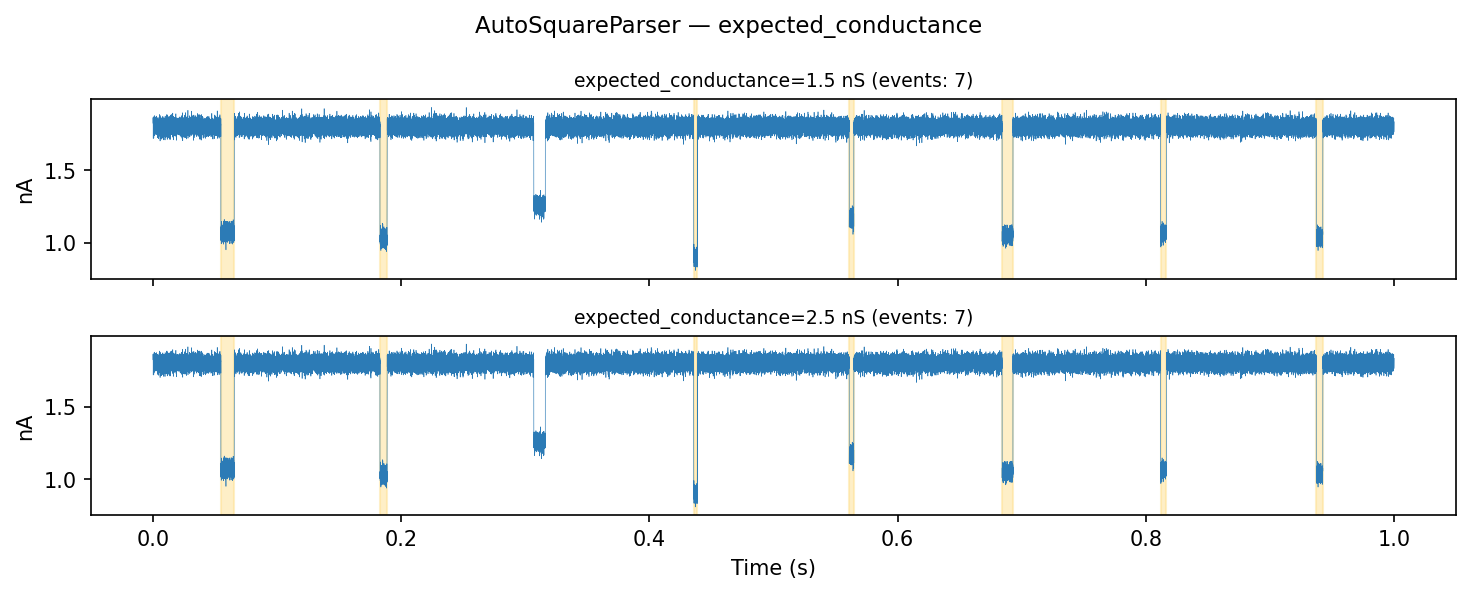
expected_conductance
Used to validate that the open-channel baseline is physically reasonable. Set this to match your nanopore’s conductance (typically 1–5 nS for solid- state pores).
Using rules for post-filtering
The rules parameter accepts lambda functions that filter events after
detection. Each rule receives a dictionary with event properties and returns
True to keep the event:
parser = AutoSquareParser(
    threshold_baseline=0.7,
    expected_conductance=1.9,
    rules=[
        lambda ev: ev["frac"] < 0.9,        # blockade must be >10% of baseline
        lambda ev: (ev["end"] - ev["start"]) > 50,  # minimum 50 samples
    ],
)
Full example
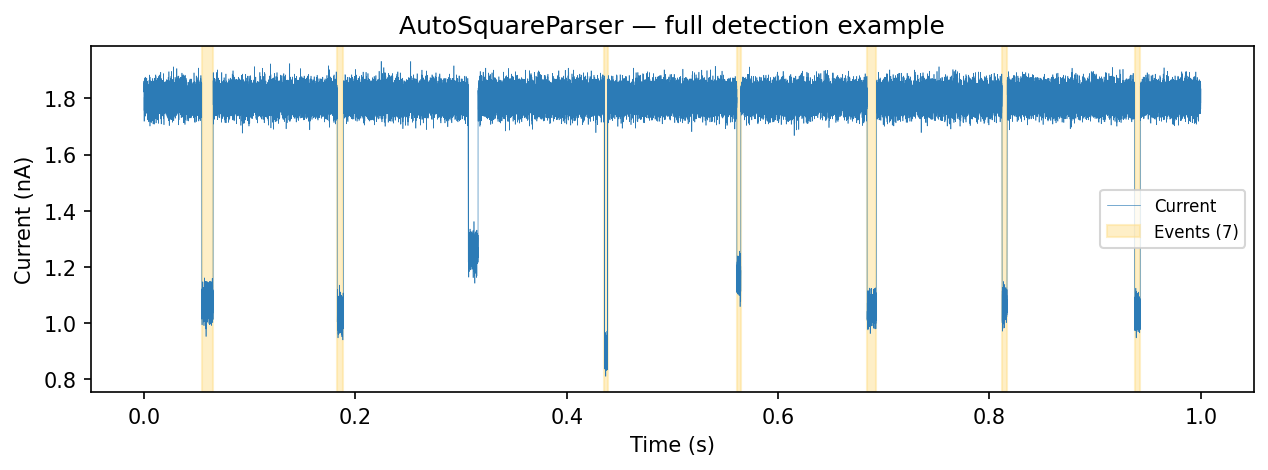
from ionique.parsers import AutoSquareParser

parser = AutoSquareParser(
    threshold_baseline=0.7,
    expected_conductance=1.9,
    wrap_padding=100,
)

trace.parse(parser, newrank="event", at_child_rank="vstep")

events = trace.traverse_to_rank("event")
print(f"Detected {len(events)} blockade events")

for ev in events[:5]:
    baseline = ev.unique_features.get("baseline", None)
    frac = ev.unique_features.get("frac", None)
    print(f"  [{ev.start}:{ev.end}] baseline={baseline:.3f}, I/I0={frac:.3f}")
Per-event features
AutoSquareParser stores additional metadata in each event’s
unique_features:
Key |
Description |
|---|---|
|
Open-channel current before the blockade (nA). |
|
Mean current during the blockade (nA). |
|
Fractional blockade depth: |
|
Context window around the event (numpy array with padding). |